

RESEARCH & INSIGHTS
Sitting There Thinking…
An insights project exploring the working class experience of football in modern Britain, supported by global men’s health charity Movember
Demo84 created listening sessions streaming audio from England's 2026 World Cup fixtures to create a brand-free environment to capture the lived experience of young, working-class football fans in Birmingham and Blackpool.
We then analysed over 1,300 commercial messages across football's digital ecosystem, and spoke with a handful of national experts across class, football culture and betting.
The findings reveal a compounding web of issues, from rising costs and shrinking social spaces to gambling-saturated second screens and rising loneliness among young men, that ultimately dents social capital.


KEY FINDINGS
01
Fans are being priced out of the game they built
We've created a new metric tracking the rising cost of football that, when compared with Real Household Disposable Income, shows a 42% gap from 2015 to 2025.
02
Gambling adapts to consumption habits in real-time while regulation stalls
We analysed 1,300+ commercial messages across the digital ecosystem and found that gambling appeared most often and was often disguised as banter or punditry.
03
Our living rooms are the new football stadiums
As the Cost of Football rises, social connection from collective experience is substitued with isolated experiences.
04
The solution is a few streets away, and it needs protecting
Non-League attendances are rising fast across the pyramid, but the clubs best placed to catch these fans have no financial safety net to catch them in return.

PROFESSOR CARL CHINN MBE
Social Historian
COST OF FOOTBALL
We combined the cost of a pint, fuel, the average Premier League season ticket price, the average kit price, and TV subscription costs in the last decade to create a new Cost of Football metric.
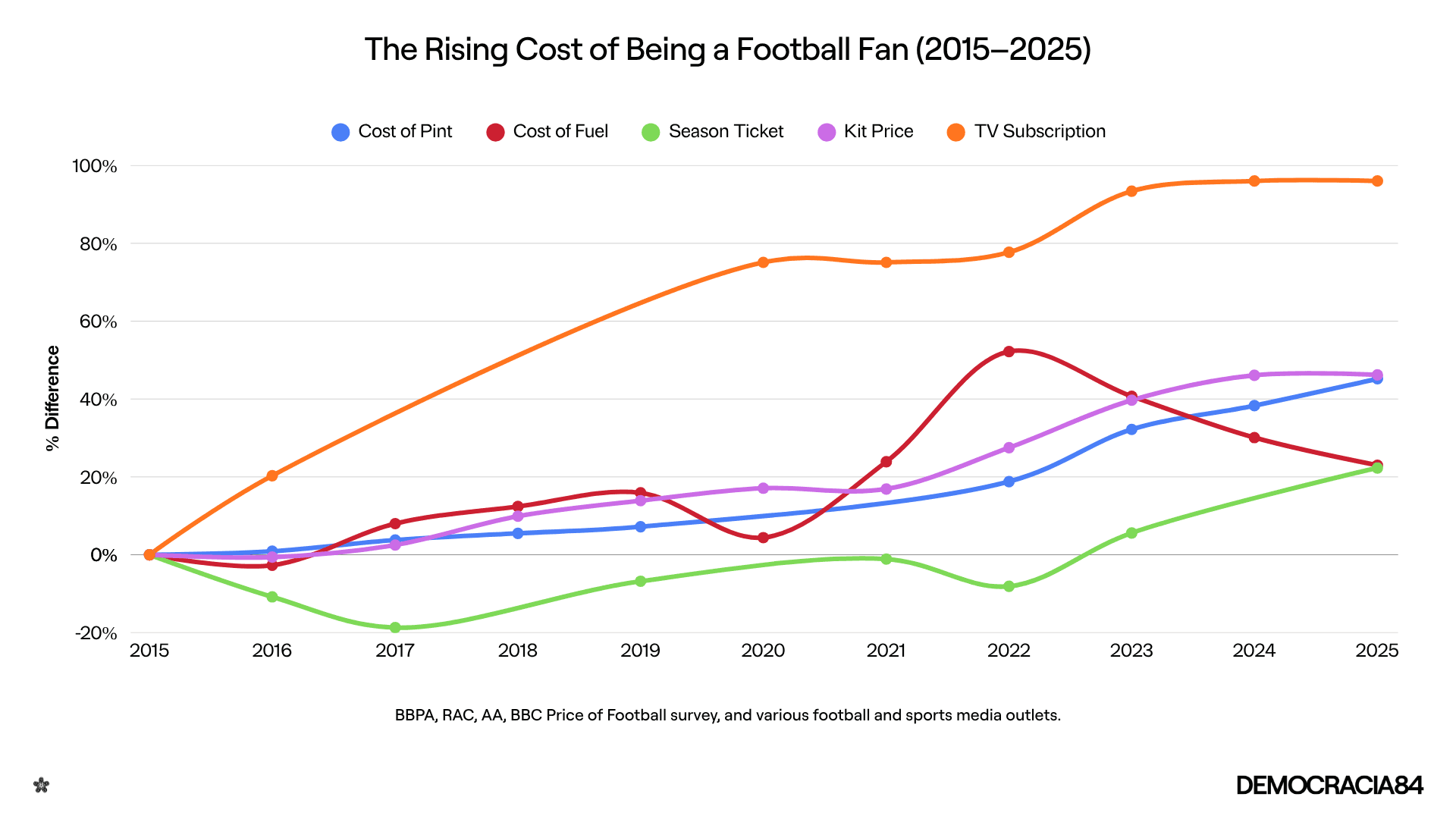

+47%
The Cost of Football has risen from 2015–2025.
42%
A stark gap when contrasted with disposable income.
WHO PAYS?
Working class fans will feel these impacts the hardest.
DR RAFFAELLO ROSSI
Senior Lecturer in Marketing, University of Bristol

THE RISE OF SECOND SCREEN CONSUMPTION
The Digital Ecosystem of Football

This model maps football's digital ecosystem: the platforms and channels fans move through after the final whistle.
As live attendance and broadcast subscriptions price fans out, they're pushed further into second-screen spaces, where football engagement is 24/7.
Here, social media, popular content creators, gaming, and livescore apps dominate the experience, and it's exactly where advertising is harder to identify, and regulation becomes thinner.
POLICY RECOMMENDATIONS
01
A ticket quota for
young fans
A statutory 10% quota of discounted Premier League tickets for under-25s, funded by a levy on transfer fees, guaranteeing access regardless of pricing trends elsewhere.
02
A content fund that shuts out harmful advertising
Premier League funding for independent creators and fan-led channels, on the condition that they carry no gambling sponsorship, giving them a real incentive to opt out.
03
One subscription,
every match
A direct Singapore-style Premier League-to-fan streaming service covering every fixture, cutting out stacked subscriptions and making illegal streaming a less attractive option.
04
A national
'second club' campaign
A talent-backed campaign encouraging fans to support a local lower division club alongside their Premier League team, turning existing community infrastructure into lasting connection.
WITH THANKS TO
This project was supported by the global men's health charity

MEDIA ENQUIRIES
For interviews, press materials or further information about this project, please contact: